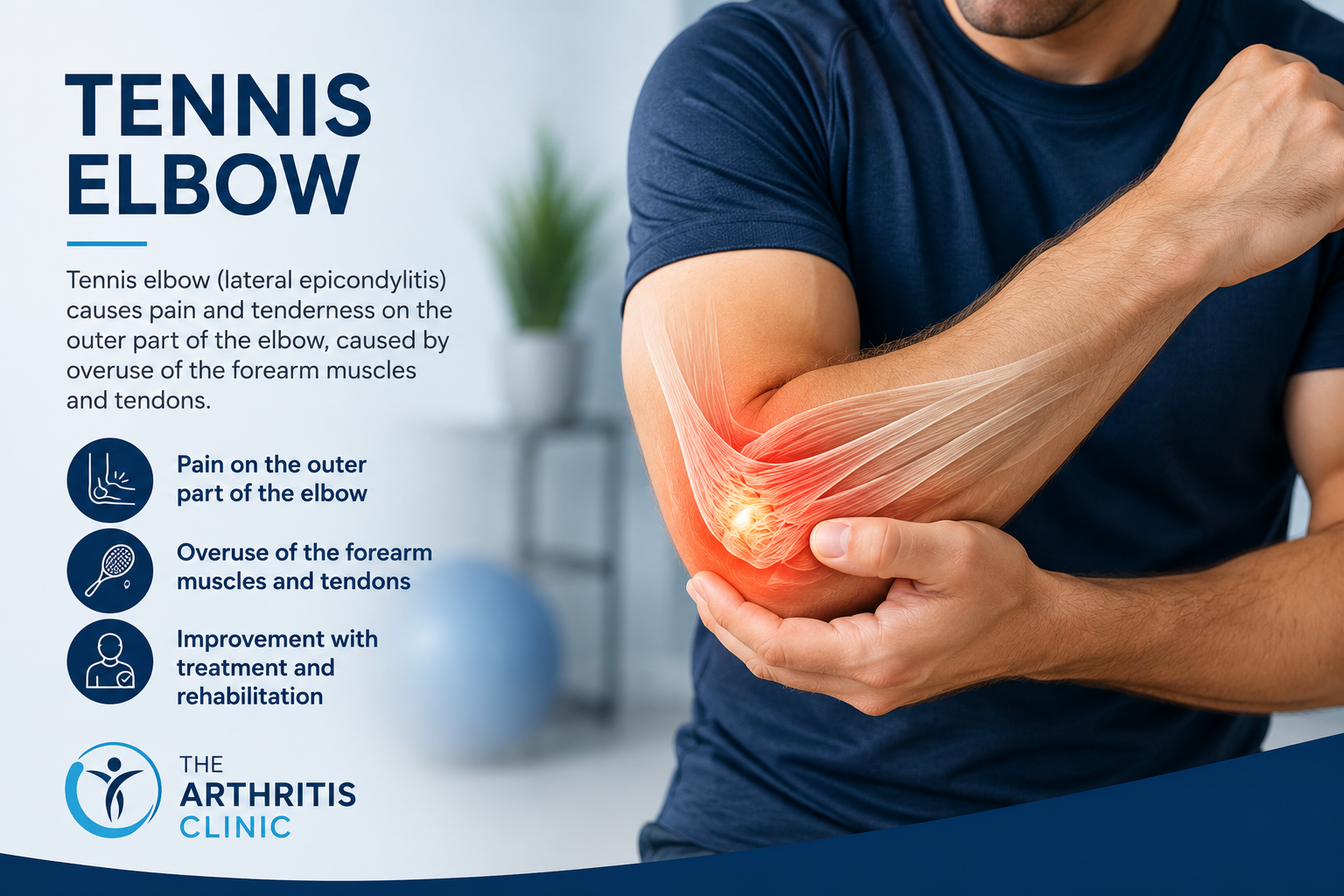
Tennis Elbow & Golfer’s Elbow in Essex
Specialist Assessment and Treatment for Tennis Elbow and Golfer’s Elbow in Billericay
Elbow pain can affect your ability to work, exercise, play sport and perform everyday activities such as lifting, gripping, typing or opening jars.
Tennis elbow and golfer’s elbow are two common causes of persistent elbow pain. Despite their names, you do not need to play tennis or golf to develop either condition.
At The Arthritis Clinic in Billericay, Essex, we provide specialist assessment and treatment for tennis elbow, golfer’s elbow and other causes of elbow and forearm pain.
Our approach combines detailed clinical assessment with evidence-based rehabilitation and, where appropriate, musculoskeletal ultrasound and treatments such as shockwave therapy.
What is tennis elbow?
Tennis elbow, also known as lateral elbow tendinopathy, causes pain around the outside of the elbow.
It commonly affects the tendons attached to the outside of the elbow and may develop when the tissues are repeatedly exposed to loads that exceed their current capacity.
You do not have to play tennis to develop tennis elbow.
Activities involving repetitive gripping, lifting, wrist movements or forearm rotation can contribute to symptoms. This can include manual work, DIY, gardening, computer use, racquet sports, weight training and other repetitive activities.
Common symptoms of tennis elbow
Symptoms can include:
- Pain on the outside of the elbow
- Tenderness around the outer elbow
- Pain extending into the forearm
- Pain when gripping objects
- Pain when lifting or carrying
- Pain when twisting the forearm
- Discomfort when moving the wrist
- Reduced grip strength
- Difficulty performing activities that require repetitive use of the arm
Symptoms can develop gradually or follow a change in activity, workload or sporting demands.
What is golfer’s elbow?
Golfer’s elbow, also known as medial elbow tendinopathy, causes pain around the inside of the elbow.
It affects the tendons associated with the muscles that bend the wrist and fingers and rotate the forearm.
Despite its name, golfer’s elbow is not restricted to golfers. It can occur following repetitive gripping, lifting, wrist movements and forearm rotation. Common activities include manual work, DIY, gardening, weight training, golf and other sports.
Common symptoms of golfer’s elbow
Symptoms may include:
- Pain on the inside of the elbow
- Tenderness around the inner elbow
- Pain extending into the forearm
- Pain when gripping
- Pain when lifting
- Pain when bending the wrist
- Pain when twisting the forearm
- Reduced grip strength
- Discomfort during sporting activities
Some people can also experience tingling or altered sensation extending towards the ring and little fingers. This can indicate involvement of the ulnar nerve and should be assessed appropriately.
Tennis Elbow vs Golfer’s Elbow
Although tennis elbow and golfer’s elbow affect opposite sides of the elbow, they have several similarities.
| Tennis Elbow | Golfer’s Elbow | |
|---|---|---|
| Medical term | Lateral elbow tendinopathy | Medial elbow tendinopathy |
| Typical location | Outside of elbow | Inside of elbow |
| Commonly affected tissues | Wrist/finger extensor tendons | Wrist/finger flexor tendons |
| Common aggravating activities | Gripping, lifting, wrist extension, forearm rotation | Gripping, lifting, wrist flexion, forearm rotation |
| Associated sports | Tennis and racquet sports | Golf and throwing sports |
| Can occur without sport? | Yes | Yes |
Both conditions are often related to repetitive or increased loading of the forearm tendons, rather than being caused by one particular sport.
What causes tennis elbow and golfer’s elbow?
Tendon pain around the elbow can occur when the demands placed on the tissues increase beyond their current capacity.
Potential contributing factors include:
- Sudden increases in exercise or sporting activity
- Repetitive gripping
- Manual work
- DIY
- Gardening
- Weight training
- Racquet sports
- Golf
- Repetitive computer or desk work
- Changes in training volume
- Poorly tolerated increases in workload
- Previous elbow or forearm problems
Importantly, there is not always a single identifiable cause.
How are tennis elbow and golfer’s elbow diagnosed?
A detailed clinical assessment is usually the most important part of diagnosing elbow tendinopathy.
Your assessment may include:
- Detailed discussion of your symptoms
- Assessment of elbow movement
- Examination of the wrist and forearm
- Grip strength assessment
- Assessment of the muscles and tendons around the elbow
- Assessment of sporting or occupational activities
- Examination of the cervical spine and shoulder where appropriate
- Neurological assessment where nerve involvement is suspected
Musculoskeletal ultrasound
At The Arthritis Clinic, musculoskeletal ultrasound may be used where clinically appropriate.
Ultrasound can provide real-time assessment of the tendons and surrounding soft tissues and may help identify tendon changes or alternative causes of elbow pain.
A scan is not always necessary. Many cases of tennis elbow and golfer’s elbow can be diagnosed clinically, with imaging reserved for situations where it may add useful information or where the diagnosis is uncertain.
Treatment for tennis elbow and golfer’s elbow
Treatment should be tailored to the individual.
For most people, progressive rehabilitation and appropriate management of activity and tendon loading form the foundation of treatment.
Physiotherapy and rehabilitation
Physiotherapy can help you understand what is contributing to your symptoms and develop a progressive programme to rebuild strength and tolerance.
Your rehabilitation may include:
- Forearm strengthening
- Wrist strengthening
- Grip strengthening
- Progressive tendon loading
- Stretching where appropriate
- Shoulder and upper-limb strengthening
- Functional exercises
- Sport-specific rehabilitation
- Advice regarding activity and workload
The objective is not simply to reduce pain but to improve the capacity of the affected tissues so that you can return to the activities that matter to you.
Gradual loading is an important part of rehabilitation for both tennis elbow and golfer’s elbow.
Activity modification
You do not necessarily need to completely stop using your arm.
Instead, we may identify the specific movements or activities that are aggravating your symptoms and modify them temporarily.
This may involve:
- Reducing repetitive gripping
- Changing lifting technique
- Adjusting sporting activity
- Modifying your gym programme
- Taking regular breaks from repetitive work
- Altering your equipment or grip
- Gradually rebuilding your activity levels
The aim is to maintain movement and function while allowing the elbow to progressively tolerate greater loads.
Shockwave therapy for tennis elbow
Shockwave therapy may be considered for some people with persistent or refractory tennis elbow.
Extracorporeal shockwave therapy uses acoustic energy delivered through the skin to the affected area.
NICE has published guidance specifically regarding extracorporeal shockwave therapy for refractory tennis elbow. The evidence and expected response should be discussed as part of an individual assessment rather than assuming that shockwave therapy will be suitable for everyone.
At The Arthritis Clinic, shockwave therapy may be incorporated into a wider rehabilitation programme where clinically appropriate.
Shockwave therapy for golfer’s elbow
Shockwave therapy may also be considered for persistent golfer’s elbow in selected patients.
However, the evidence base is less established than for some other conditions, and treatment should be considered on an individual basis.
Where shockwave therapy is used, we recommend combining it with an appropriate rehabilitation and progressive loading programme rather than relying on passive treatment alone.
Ultrasound-guided assessment
Where appropriate, musculoskeletal ultrasound can help assess the structure of the affected tendons and surrounding tissues.
This can be particularly useful when:
- Symptoms are persistent
- The diagnosis is uncertain
- There has been significant trauma
- Symptoms are not following the expected pattern
- Another tendon or soft-tissue problem needs to be considered
What about steroid injections?
Steroid injections need to be considered carefully in elbow tendinopathy.
Although corticosteroid injections can sometimes provide short-term pain relief, evidence from NHS musculoskeletal guidance suggests that they may have less favourable longer-term outcomes in tennis elbow and may adversely affect the benefits of exercise-based rehabilitation.
For this reason, steroid injection should not automatically be considered the first treatment for tennis or golfer’s elbow.
At The Arthritis Clinic, treatment options are discussed according to the individual’s diagnosis, symptoms, previous treatment and goals.
How long does tennis elbow or golfer’s elbow take to improve?
Tendon-related elbow pain can be frustrating because improvement is often gradual.
Many people improve with appropriate self-management and rehabilitation, but symptoms can persist for several months and sometimes longer.
This does not necessarily mean that the tendon is continuing to become damaged.
Recovery can depend on:
- How long symptoms have been present
- Your activity levels
- Your occupation
- Sporting demands
- The amount of repetitive loading
- Your strength and conditioning
- Previous episodes of elbow pain
- Other musculoskeletal conditions
A structured rehabilitation programme can help you progressively increase the amount of load your elbow can tolerate.
Can I continue playing tennis or golf?
Often, yes.
You may not need to completely stop playing sport.
Depending on your symptoms, we may recommend temporarily modifying:
- Frequency of play
- Duration of sessions
- Training intensity
- Grip size or technique
- Equipment
- Repetitive practice
- Strength and conditioning workload
The goal is to gradually return to your normal sporting activity without repeatedly exceeding the capacity of the affected tissues.
When should you seek assessment for elbow pain?
Consider professional assessment if:
- Your elbow pain has persisted for several weeks
- Your symptoms are affecting work or sport
- You have difficulty gripping or lifting
- Your pain is getting worse
- You have tried self-management without sufficient improvement
- You have significant weakness
- You develop persistent numbness or tingling
- Your symptoms followed a significant injury
Urgent assessment may be required following significant trauma, if the elbow has changed shape, if you have severe difficulty moving the arm, or if you develop significant swelling, redness, fever or neurological symptoms.
Specialist Tennis Elbow and Golfer’s Elbow Treatment in Essex
At The Arthritis Clinic in Billericay, we provide specialist assessment and treatment for tennis elbow, golfer’s elbow and other causes of elbow and forearm pain.
Our approach may include:
Clinical assessment → Musculoskeletal ultrasound where appropriate → Physiotherapy and rehabilitation → Progressive tendon loading → Shockwave therapy where appropriate → Return to work, sport and normal activity
We aim to identify the likely source of your elbow pain and develop a treatment plan based on your symptoms, lifestyle, occupation and goals.
Book an Elbow Pain Assessment in Billericay
If persistent elbow pain is affecting your work, exercise, sport or everyday life, contact The Arthritis Clinic to arrange a specialist assessment.
Frequently Asked Questions
What is the difference between tennis elbow and golfer’s elbow?
Tennis elbow usually causes pain on the outside of the elbow, whereas golfer’s elbow causes pain on the inside of the elbow. Both are commonly associated with problems involving the tendons of the forearm.
Can you get tennis elbow without playing tennis?
Yes. Tennis elbow can occur following repetitive gripping, lifting, computer work, DIY, gardening, manual work and other activities involving the wrist and forearm.
Can you get golfer’s elbow without playing golf?
Yes. Golfer’s elbow can develop from repetitive gripping, lifting and wrist or forearm movements and can affect people who have never played golf.
Is tennis elbow a tendon problem?
Tennis elbow is commonly described as lateral elbow tendinopathy and involves the tendons and associated tissues around the outside of the elbow.
Does tennis elbow need an ultrasound scan?
Not necessarily. Many cases can be diagnosed clinically. Ultrasound may be useful where the diagnosis is uncertain, symptoms are persistent or additional information about the tendon is required.
Is shockwave therapy good for tennis elbow?
Shockwave therapy may be considered for persistent or refractory tennis elbow. NICE has specific guidance on extracorporeal shockwave therapy for refractory tennis elbow, and suitability should be assessed on an individual basis.
How long does tennis elbow last?
Tennis elbow can improve gradually over weeks or months, although some people experience symptoms for considerably longer. Progressive rehabilitation and appropriate activity modification can support recovery.
Can physiotherapy help tennis elbow?
Physiotherapy can help with education, activity modification and progressive strengthening of the forearm and upper limb. Exercise-based rehabilitation is an important component of managing tennis elbow.