Lower Back Pain & Sciatica in Essex
Specialist Back Pain and Sciatica Assessment in Billericay, Essex
Lower back pain is extremely common and can affect people of all ages. It may develop gradually through changes in activity, muscular or joint problems, or repetitive loading, or it can begin suddenly following an injury or movement.
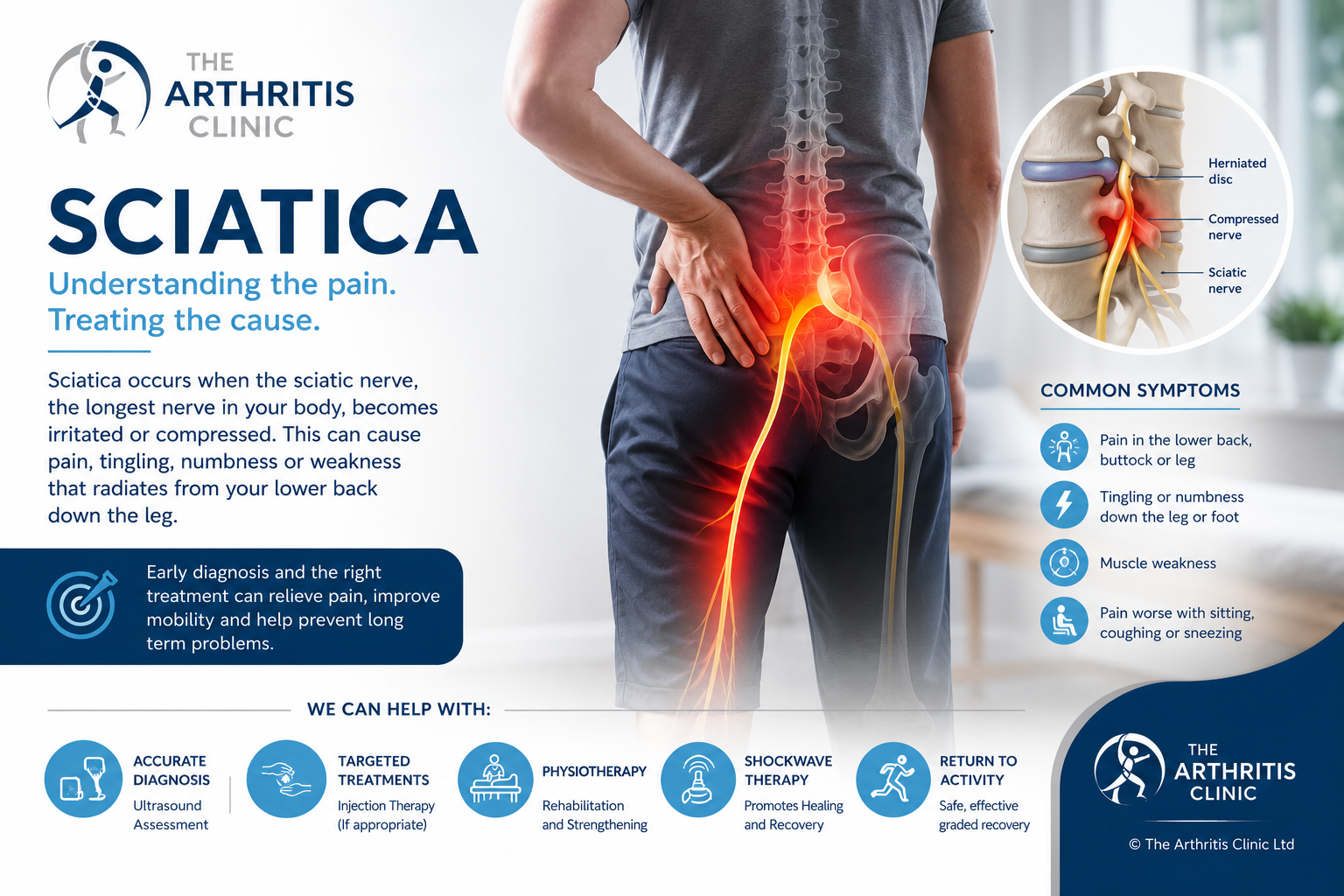
Sciatica is different from ordinary lower back pain. It occurs when a nerve or nerve roots in the lower back become irritated or compressed, causing symptoms that can travel from the back or buttock into the leg.
At The Arthritis Clinic in Billericay, Essex, we provide specialist assessment and treatment for lower back pain, sciatica and a range of musculoskeletal conditions affecting the spine, pelvis and lower limbs.
Our approach is to understand your symptoms, identify the likely source of your problem and develop an individual treatment plan designed around your function, lifestyle and goals.
What Causes Lower Back Pain?
Lower back pain can have many different causes. In many cases, there is not one single structure that can be identified as the cause.
Common contributors can include:
- Muscular or soft-tissue problems
- Joint-related pain
- Disc-related problems
- Degenerative changes
- Reduced strength or physical conditioning
- Changes in activity or training load
- Previous injury
- Persistent or recurrent back pain
- Poor tolerance to particular movements or activities
Less commonly, back pain can be associated with inflammatory conditions, infection, fracture, cancer or other medical problems. This is why appropriate assessment is important, particularly when symptoms are unusual, severe or persistent.
What Is Sciatica?
Sciatica describes symptoms caused by irritation or compression of nerves in the lower back.
Typical symptoms may include:
- Pain travelling from the lower back or buttock into the leg
- Pain extending below the knee
- Tingling or pins and needles
- Numbness
- Burning or shooting pain
- Weakness in the leg or foot
Sciatica usually affects one side, although symptoms can vary between individuals.
It is important to distinguish sciatica from general lower back pain because the assessment and management may be different.
Sciatica and Disc Problems
One potential cause of sciatica is a herniated or slipped disc, where disc material can irritate or compress a nerve.
However, not everyone with a disc bulge or degenerative change has symptoms, and imaging findings do not always correspond directly with the severity of pain.
For this reason, imaging should generally be interpreted alongside your symptoms and clinical examination rather than treated as a diagnosis in isolation.
Symptoms of Lower Back Pain
Lower back pain can present in many different ways, including:
- Aching or stiffness
- Sharp or catching pain
- Pain with bending
- Pain with lifting
- Pain after prolonged sitting
- Pain when standing or walking
- Reduced movement
- Muscle tightness
- Pain extending into the buttock
- Difficulty exercising or returning to normal activities
Persistent back pain can also affect sleep, work, confidence and physical activity.
Symptoms of Sciatica
Sciatica can produce a different pattern of symptoms, particularly when a nerve is irritated.
You may experience:
- Shooting or electric-type pain
- Burning pain
- Numbness or altered sensation
- Pins and needles
- Leg pain
- Foot or ankle symptoms
- Weakness
- Difficulty walking or standing for prolonged periods
If you develop significant or progressive weakness, or changes to bladder or bowel function, urgent medical assessment is required.
Physiotherapy for Lower Back Pain
Physiotherapy can play an important role in the management of many forms of lower back pain.
Your rehabilitation programme may include:
- Strengthening exercises
- Core and trunk conditioning
- Hip and lower-limb strengthening
- Mobility exercises
- Progressive resistance training
- Movement retraining
- Education about pain and activity
- Activity modification
- Graded return to exercise
- Functional rehabilitation
The objective is not simply to provide short-term pain relief. We aim to help you develop the strength, movement, confidence and physical capacity required to return to normal activities.
NICE recommends exercise and physical activity as important components of managing low back pain and sciatica.
Physiotherapy for Sciatica
Many people with sciatica improve over time without surgery.
Physiotherapy can help you understand your symptoms and develop an appropriate programme to maintain movement and gradually restore strength and function.
Treatment may involve:
- Individualised exercise
- Progressive strengthening
- Mobility exercises
- Neural mobility where clinically appropriate
- Movement retraining
- Education and self-management
- Gradual return to normal activity
The precise programme depends on your symptoms and clinical findings.
Do I Need an MRI for Back Pain or Sciatica?
Not necessarily.
Imaging is not routinely required for uncomplicated lower back pain or sciatica. NICE recommends considering imaging in specialist settings when the result is likely to change management.
An MRI may be appropriate in selected circumstances, particularly when there are neurological symptoms, persistent symptoms despite appropriate treatment, or when a specific structural problem is suspected.
At The Arthritis Clinic, we can assess your symptoms and advise when further investigation or referral may be appropriate.
Lower Back Pain and Exercise
It is understandable to be cautious about exercise when your back hurts.
However, prolonged inactivity can contribute to deconditioning and loss of confidence with movement. For many people with lower back pain, gradually returning to normal physical activity is an important part of recovery.
Your exercise programme should be appropriate to your symptoms and progressed gradually.
This might include:
- Walking
- Strength training
- Core and trunk exercises
- Hip strengthening
- Mobility work
- Cardiovascular exercise
- Functional exercises
- Gradual return to sport
The aim is to build your capacity rather than avoid movement indefinitely.
Manual Therapy for Back Pain
Manual therapy may be considered as part of a broader physiotherapy programme for some people with lower back pain.
This can include selected:
- Joint mobilisation techniques
- Soft-tissue techniques
- Massage
- Movement-based treatment
NICE recommends that manual therapy should be considered alongside exercise rather than as a stand-alone treatment for low back pain and sciatica.
Injections for Lower Back Pain and Sciatica
Injection treatments are not appropriate for every type of back pain.
The role of injections depends on the suspected diagnosis, symptoms and clinical circumstances. Where specialist intervention is required, patients may be referred for appropriate pain management, spinal or surgical assessment.
At The Arthritis Clinic, our priority is to establish whether your symptoms are suitable for conservative physiotherapy and rehabilitation or whether further investigation or specialist referral is required.
Lower Back Pain and Sciatica in Active People
Back pain and sciatica can be particularly frustrating when they interfere with exercise, sport or physical work.
Our rehabilitation approach can help you progressively rebuild:
- Strength
- Mobility
- Load tolerance
- Cardiovascular fitness
- Movement confidence
- Sport-specific capacity
The aim is to help you return to the activities you enjoy rather than simply avoid movements that provoke symptoms.
When Should I Seek Help for Back Pain?
You should consider professional assessment if your back pain:
- Has persisted for several weeks
- Is getting worse
- Keeps returning
- Is affecting your sleep
- Is preventing you from exercising
- Is affecting work or everyday activities
- Is associated with persistent leg pain
- Is associated with numbness or tingling
- Is associated with weakness
Most episodes of uncomplicated lower back pain improve with time and appropriate self-management, but persistent or worsening symptoms should be assessed.
When Is Back Pain an Emergency?
Certain symptoms require urgent medical assessment.
Seek immediate medical attention if back pain is accompanied by:
- Numbness around the genitals, anus or buttocks
- New difficulty controlling your bladder or bowel
- Inability to pass urine
- Significant or rapidly worsening weakness in both legs
- Severe or worsening neurological symptoms
These can be signs of cauda equina syndrome, a rare but serious condition requiring urgent assessment.
Urgent medical assessment may also be appropriate when severe back pain follows significant trauma, or when there are other concerning symptoms such as fever or unexplained weight loss.
If you have concerns that your symptoms could represent an emergency, you should seek urgent medical attention rather than waiting for a routine physiotherapy appointment.
Frequently Asked Questions About Lower Back Pain and Sciatica
What is the difference between back pain and sciatica?
Lower back pain is pain centred around the lower back and may have many causes. Sciatica specifically refers to symptoms caused by irritation or compression of nerves in the lower back, typically producing pain or altered sensation travelling into the leg.
How do I know if I have sciatica?
Sciatica commonly produces pain travelling from the lower back or buttock into the leg, sometimes accompanied by tingling, numbness or weakness. A clinical assessment is the best way to determine whether your symptoms are consistent with sciatica.
Can physiotherapy help sciatica?
Physiotherapy can form an important part of managing sciatica. Treatment may include exercise, strengthening, mobility work, education and a gradual return to normal activity.
Should I rest if I have sciatica?
Prolonged bed rest is generally not recommended for uncomplicated sciatica. Maintaining appropriate activity and gradually returning to normal movement is usually encouraged, although your activity may need to be modified according to your symptoms.
Is walking good for lower back pain?
Walking is often a useful form of low-impact activity for people with lower back pain, provided it is tolerated. The appropriate amount will vary according to your symptoms and physical capacity.
Can a slipped disc cause sciatica?
Yes. A herniated disc can irritate or compress a spinal nerve and cause sciatica. However, disc changes are also common in people without symptoms, so imaging findings need to be interpreted alongside the clinical picture.
Do I need an MRI for sciatica?
Not necessarily. MRI is not routinely required for uncomplicated sciatica. It may be considered when symptoms are persistent, significant neurological problems are present, or imaging is likely to change management.
Can a physiotherapist diagnose a slipped disc?
A physiotherapist can assess your symptoms and neurological function and determine whether your presentation may be consistent with a disc-related problem. Where imaging or medical assessment is required, you can be referred appropriately.
Can lower back pain be caused by arthritis?
Yes. Degenerative changes affecting the spine can contribute to back pain, although imaging findings do not always explain symptoms. Other structures and factors may also contribute to pain.
Can strengthening exercises help lower back pain?
Strengthening and general physical activity can be important components of managing persistent lower back pain. Exercise should be appropriately selected and progressed according to your symptoms and goals.
Can I exercise with lower back pain?
In many cases, yes. Appropriate exercise is generally preferable to prolonged inactivity. The type and intensity of exercise should be adapted to your symptoms and gradually progressed.
Can manual therapy help back pain?
Manual therapy may provide short-term symptom relief for some people, but NICE recommends that it should be used alongside an exercise programme rather than as a stand-alone treatment.
Can sciatica cause numbness?
Yes. Irritation or compression of a spinal nerve can cause altered sensation, including numbness and pins and needles.
Can sciatica cause weakness?
Yes. Significant nerve irritation can affect muscle strength. New or progressive weakness should be assessed promptly.
When should I worry about sciatica?
Seek urgent medical attention if you develop numbness around the genitals or anus, difficulty controlling your bladder or bowel, inability to pass urine, or significant/worsening weakness affecting both legs. These can be warning signs of cauda equina syndrome.
How long does sciatica take to improve?
Recovery varies considerably. Many people improve with time and conservative management, but some experience persistent symptoms requiring further assessment or specialist treatment.
Can injections cure sciatica?
Injections are not a cure for sciatica. In selected circumstances, specialist spinal injections may be considered for symptom management, but the appropriate treatment depends on the underlying cause and clinical presentation.
Can back pain come from the hip?
Yes. Hip problems can sometimes produce pain around the buttock, groin or thigh and can overlap with symptoms attributed to the lower back. A detailed assessment can help distinguish between hip and spinal sources of pain.
Can back pain come from the sacroiliac joint?
The sacroiliac joints can contribute to pain around the lower back and buttock, although diagnosing the exact source of pain in this region can be complex. Clinical assessment is important.
Lower Back Pain and Sciatica Treatment in Billericay, Essex
If lower back pain or sciatica is affecting your ability to work, exercise, sleep or enjoy everyday life, The Arthritis Clinic in Billericay, Essex, provides specialist musculoskeletal assessment and physiotherapy.
We see patients from Billericay, Basildon, Wickford and surrounding areas of Essex, providing assessment, rehabilitation and appropriate non-surgical treatment.
Our aim is to understand why you are experiencing back or leg pain and what you can do to improve your movement, strength and function.
Book a specialist lower back pain or sciatica assessment at The Arthritis Clinic.