Hip Osteoarthritis Treatment in Essex
Specialist Assessment and Treatment for Hip Osteoarthritis in Billericay
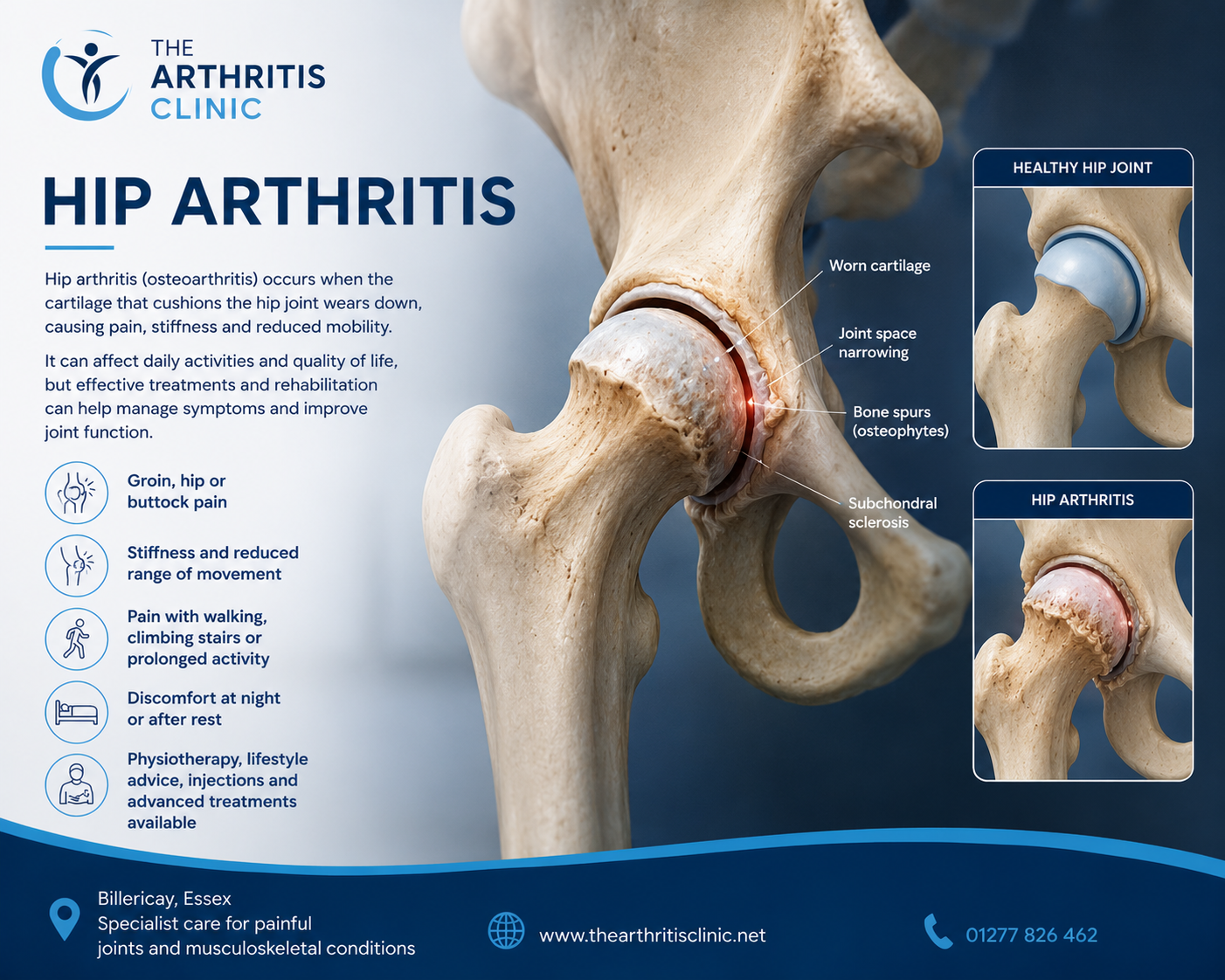
Hip osteoarthritis is a common cause of persistent hip pain, stiffness and reduced mobility. It can affect walking, exercise, work, sleep and everyday activities such as getting into a car, climbing stairs or putting on shoes and socks.
At The Arthritis Clinic in Billericay, Essex, we provide specialist assessment and treatment for hip osteoarthritis and other causes of hip pain.
Our approach combines detailed clinical assessment, physiotherapy and rehabilitation with appropriate imaging and treatment options where clinically indicated.
What is hip osteoarthritis?
Osteoarthritis is a long-term condition affecting the joints. In the hip, changes can occur within the cartilage, bone and other tissues surrounding the joint.
These changes can contribute to pain, stiffness and reduced movement.
Hip osteoarthritis does not affect everyone in the same way. Some people have relatively mild symptoms, while others can experience significant pain and functional limitations.
Importantly, the appearance of osteoarthritis on an X-ray does not always correspond directly to the amount of pain someone experiences. Your symptoms, function and clinical assessment are therefore important when deciding on treatment.
What does hip osteoarthritis feel like?
Hip osteoarthritis can cause:
- Pain in the groin
- Pain around the front of the hip
- Pain around the outside of the hip
- Pain extending into the thigh
- Buttock pain
- Hip stiffness
- Reduced hip movement
- Difficulty walking longer distances
- Pain when climbing stairs
- Difficulty getting in and out of a car
- Difficulty putting on shoes and socks
- Pain when standing for prolonged periods
- Pain after periods of inactivity
- Pain during or after exercise
Hip osteoarthritis can sometimes cause pain at rest or during the night, particularly when symptoms are more advanced.
What causes hip osteoarthritis?
There is rarely one single cause of hip osteoarthritis.
Factors associated with the development of osteoarthritis can include:
- Increasing age
- Previous hip injury
- Previous hip surgery
- Hip abnormalities or structural differences
- Previous joint disease
- Family history
- Increased body weight
- Repetitive or high-load activities
Having one or more of these factors does not mean that you will necessarily develop symptomatic hip osteoarthritis.
Can exercise cause hip arthritis?
Exercise itself does not automatically cause osteoarthritis.
In fact, regular physical activity and appropriately prescribed exercise are important components of managing hip osteoarthritis.
The key is finding the appropriate level and type of loading for your individual symptoms and physical capacity. NICE recommends tailored therapeutic exercise for people with osteoarthritis, including muscle strengthening and aerobic fitness.
How is hip osteoarthritis diagnosed?
Hip osteoarthritis can often be diagnosed clinically using your symptoms, history and physical examination.
Your assessment may include:
- Detailed discussion of your symptoms
- Assessment of hip movement
- Strength testing
- Walking and functional assessment
- Assessment of the lumbar spine
- Examination of the knee and surrounding structures
- Assessment of your activity levels
- Consideration of previous injuries and surgery
Other causes of hip and groin pain may also need to be considered.
Do I need an X-ray or scan?
Imaging is not automatically required to diagnose osteoarthritis.
NICE recommends that osteoarthritis is generally diagnosed clinically and that imaging should not routinely be used to diagnose it unless there is diagnostic uncertainty or another condition needs to be investigated.
However, imaging can sometimes be useful when symptoms are unusual, severe or not following the expected pattern.
At The Arthritis Clinic, we can assess whether further imaging or referral is appropriate.
Treatment for hip osteoarthritis
There is no single treatment that works for everyone with hip osteoarthritis.
Treatment should be tailored around your symptoms, physical function, lifestyle and goals.
The core approach generally involves exercise, education and appropriate management of risk factors, with additional treatments considered when required.
Physiotherapy for hip osteoarthritis
Physiotherapy and therapeutic exercise are important components of managing hip osteoarthritis.
A tailored rehabilitation programme may focus on:
- Hip strengthening
- Gluteal strengthening
- Lower-limb strength
- Core strength
- Mobility
- Balance
- Cardiovascular fitness
- Functional exercises
- Walking tolerance
- Stair climbing
- Return to recreational activities
Exercise may initially cause some discomfort, particularly when starting or increasing activity. However, maintaining an appropriate and progressive exercise programme can improve pain and physical function over time.
At The Arthritis Clinic, we can develop a rehabilitation programme around your individual goals.
Staying active with hip osteoarthritis
A diagnosis of hip osteoarthritis does not necessarily mean you need to stop exercising.
Depending on your symptoms, suitable activities may include:
- Walking
- Cycling
- Swimming
- Strength training
- Gym-based exercise
- Low-impact cardiovascular exercise
- Progressive functional exercise
The most appropriate activity depends on your symptoms, current fitness and physical capacity.
The aim is to build your tolerance rather than avoid movement altogether.
Weight management and hip osteoarthritis
If you are living with overweight or obesity, weight management can form an important part of osteoarthritis treatment.
NICE recommends discussing weight loss with people with osteoarthritis who are living with overweight or obesity. Weight loss can improve quality of life and physical function and reduce pain, with greater benefits generally seen with greater weight loss.
Any weight-management approach should be realistic and sustainable.
Hip injections for osteoarthritis
For some people with hip osteoarthritis, an injection may be considered as part of their overall treatment plan.
Ultrasound-guided hip injection
Because the hip joint is relatively deep, image guidance can be useful when an injection into the joint is being considered.
At The Arthritis Clinic, ultrasound-guided injections can allow the clinician to visualise the relevant anatomy during the procedure.
This may be considered when pain is significantly limiting rehabilitation or other appropriate treatments have not provided sufficient symptom relief.
Corticosteroid injections
An intra-articular corticosteroid injection may provide short-term pain relief for some people with osteoarthritis.
NICE recommends considering intra-articular corticosteroid injections when other pharmacological treatments are ineffective or unsuitable, while recognising that the benefit is generally temporary.
An injection should therefore be considered as part of a broader management plan rather than as a standalone treatment for hip osteoarthritis.
What about hyaluronic acid injections for hip arthritis?
It is important to distinguish between different joints and different evidence bases.
Current NICE guidance states that intra-articular hyaluronan injections should not be offered for osteoarthritis.
At The Arthritis Clinic, treatment recommendations are based on the current evidence and the individual clinical presentation.
Can hip osteoarthritis be treated without surgery?
Yes.
Many people can manage their symptoms for considerable periods with non-surgical treatment.
This can include:
- Therapeutic exercise
- Strength training
- Physical activity
- Weight management where appropriate
- Activity modification
- Pain-management strategies
- Walking aids where appropriate
- Physiotherapy
- Other individually appropriate treatments
NHS guidance also highlights exercise, weight management, walking aids and physiotherapy as options that may be used before hip replacement surgery.
However, if symptoms become severe and substantially affect quality of life despite appropriate non-surgical treatment, hip replacement may be considered.
When is hip replacement considered?
Hip replacement is commonly used to treat pain and disability caused by hip osteoarthritis.
NICE recommends considering referral for joint replacement when hip symptoms substantially affect quality of life and non-surgical management is ineffective or unsuitable.
A hip replacement may be appropriate when persistent pain and stiffness are significantly affecting:
- Walking
- Exercise
- Work
- Sleep
- Social activities
- Independence
- Everyday activities
The decision should be based on your symptoms and functional impact rather than simply the appearance of an X-ray.
NHS guidance confirms that hip replacement is most commonly used for osteoarthritis and can significantly improve pain and daily function for many people.
Can I exercise with hip osteoarthritis?
Yes.
Exercise is one of the most important components of managing osteoarthritis.
It can help improve:
- Strength
- Mobility
- Cardiovascular fitness
- Physical function
- Confidence with movement
- Pain and stiffness
The type and intensity of exercise should be adjusted according to your current symptoms and physical capacity.
If walking is painful, alternatives such as cycling, swimming or appropriately prescribed gym-based exercise may allow you to remain active while gradually building capacity.
How long does hip osteoarthritis take to improve?
Osteoarthritis is a long-term condition, but symptoms can fluctuate considerably.
Some people experience relatively stable symptoms, while others experience periods of increased pain and stiffness.
Improvement from exercise and rehabilitation is usually gradual rather than immediate.
Your response can depend on:
- The severity of symptoms
- Your strength and fitness
- How long symptoms have been present
- Previous injuries
- Your activity levels
- Body weight where relevant
- Other medical or mu