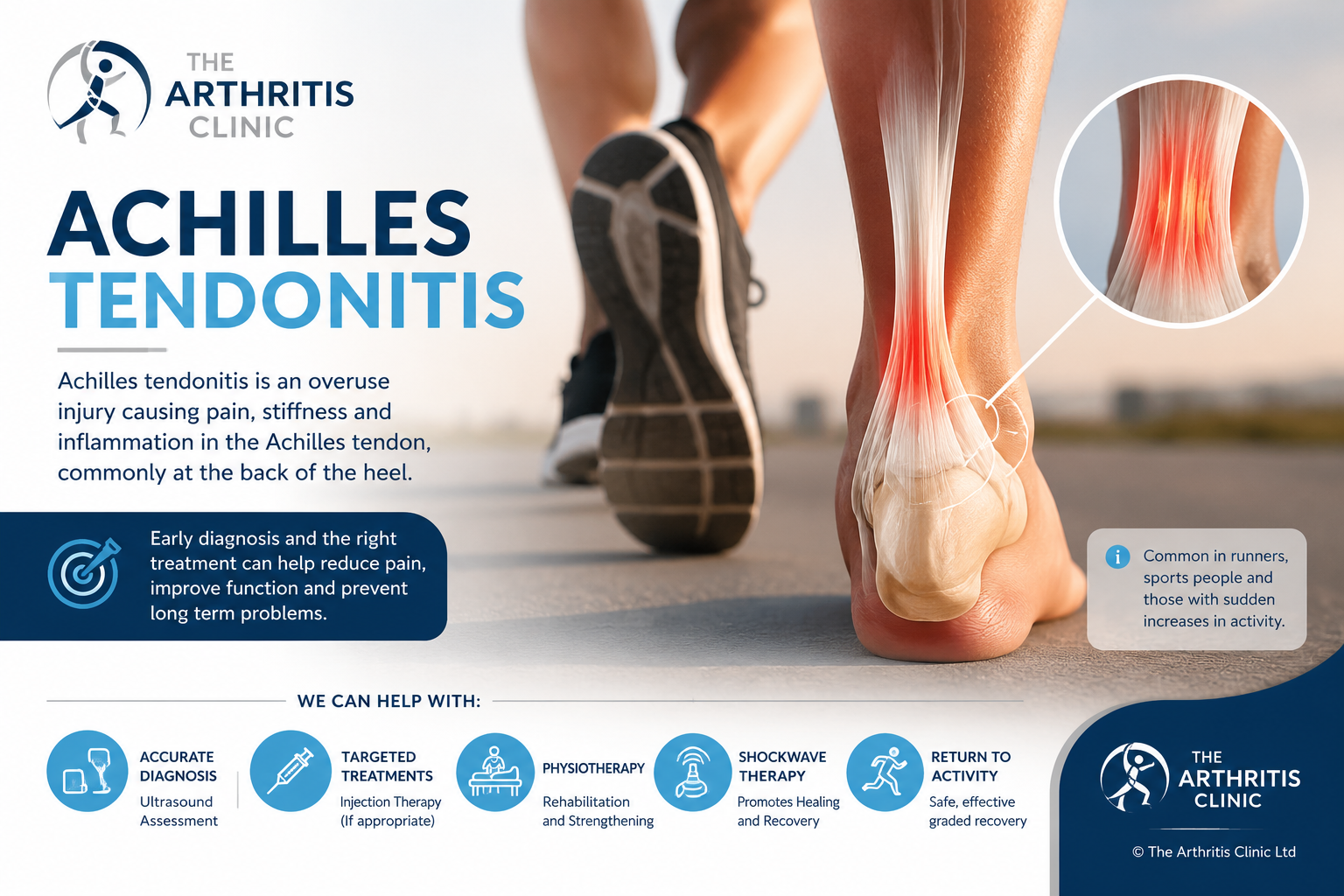
Achilles Tendinopathy in Essex
Specialist Assessment and Treatment for Achilles Tendon Pain in Billericay
Achilles tendinopathy is a common cause of pain and stiffness around the back of the ankle and heel. It can affect runners and other active people, but you do not need to be sporty to develop Achilles tendon pain.
Symptoms can interfere with walking, running, work, exercise and everyday activities. Achilles tendinopathy can also become persistent if the tendon is repeatedly exposed to loads that exceed its current capacity.
At The Arthritis Clinic in Billericay, Essex, we provide specialist assessment and treatment for Achilles tendinopathy, Achilles tendon pain and other foot and ankle conditions.
Our approach combines detailed clinical assessment, progressive rehabilitation and, where appropriate, musculoskeletal ultrasound and shockwave therapy.
What is Achilles tendinopathy?
The Achilles tendon connects the calf muscles to the heel bone. It is one of the largest and strongest tendons in the body and plays an important role in walking, running, jumping and pushing off from the ground.
Achilles tendinopathy describes a painful condition affecting the Achilles tendon, commonly associated with changes within the tendon and its ability to tolerate load.
The condition was historically referred to as “Achilles tendonitis”, but tendinopathy is generally a more appropriate term because persistent tendon problems are not simply an inflammatory condition.
Achilles tendinopathy can occur at different locations along the tendon and is commonly divided into:
- Mid-portion Achilles tendinopathy – pain and tenderness within the tendon, usually several centimetres above the heel.
- Insertional Achilles tendinopathy – pain where the Achilles tendon attaches to the heel bone.
The distinction is important because rehabilitation and exercise selection may differ between the two.
What does Achilles tendinopathy feel like?
Common symptoms include:
- Pain at the back of the ankle
- Pain around the Achilles tendon
- Pain close to the heel
- Morning stiffness
- Pain when walking
- Pain when running
- Pain during or after exercise
- Tenderness when pressing the tendon
- Swelling or thickening around the tendon
- Weakness when pushing off
- Difficulty performing a single-leg heel raise
Symptoms can sometimes improve as you warm up but become more noticeable afterwards.
Persistent Achilles tendinopathy can gradually affect your ability to walk, run or participate in sport.
What causes Achilles tendinopathy?
Achilles tendinopathy is often associated with a change in the amount or type of load placed through the tendon.
This can include:
- Increasing running mileage
- Increasing running speed or intensity
- Introducing hill running
- Starting a new sport
- Increasing jumping or plyometric exercise
- Sudden increases in gym training
- Changes in footwear
- Reduced calf strength
- Reduced conditioning
- Changes in activity levels
- Returning to sport after a period of inactivity
It can also develop without one obvious triggering event.
The tendon is continually adapting to the demands placed upon it. Problems can arise when the rate of loading exceeds the tendon’s current capacity.
Achilles Tendinopathy in Runners
Achilles tendon pain is particularly common among runners.
Changes in training can increase the demands placed on the tendon, including:
- Increasing weekly mileage
- Introducing intervals
- Running faster
- Hill training
- Changing running surfaces
- Increasing training frequency
- Returning to running after an injury
A sudden increase in training does not necessarily mean that running has “damaged” the tendon. Instead, it may indicate that the tendon needs time to adapt to the increased load.
A structured rehabilitation programme can help progressively rebuild the tendon’s capacity.
How is Achilles tendinopathy diagnosed?
Achilles tendinopathy can often be diagnosed through a detailed clinical assessment.
Your assessment may include:
- Detailed history of your symptoms
- Examination of the Achilles tendon
- Assessment of calf strength
- Single-leg heel raise assessment
- Assessment of ankle movement
- Walking and running assessment where appropriate
- Functional assessment
- Assessment of training and activity levels
- Evaluation of footwear and recent changes in activity
Other causes of heel and ankle pain may also need to be considered.
Musculoskeletal ultrasound for Achilles tendinopathy
At The Arthritis Clinic, musculoskeletal ultrasound may be used where clinically appropriate.
Ultrasound can provide real-time imaging of the Achilles tendon and surrounding tissues and can help identify changes such as tendon thickening, altered tendon structure or other abnormalities.
Clinical examination is often sufficient to diagnose Achilles tendinopathy, so an ultrasound scan is not automatically required for every patient.
Ultrasound may be particularly useful when:
- Symptoms are persistent
- The diagnosis is uncertain
- The severity of tendon changes needs further assessment
- Another tendon or soft-tissue problem needs to be considered
- A partial tear is suspected
- Treatment planning requires additional information
Treatment for Achilles Tendinopathy
Treatment should be tailored to the individual and the location and severity of the tendon problem.
For most people, progressive strengthening and appropriate management of tendon loading are central to rehabilitation. NHS specialist services describe strengthening programmes as a key component of treatment and note that meaningful improvement can take several months.
Physiotherapy and Achilles rehabilitation
Physiotherapy can help you understand your symptoms and develop a progressive programme to improve the capacity of the Achilles tendon and calf muscles.
Your rehabilitation may include:
- Calf strengthening
- Heel raises
- Isometric exercises
- Progressive resistance training
- Balance and proprioception
- Ankle mobility exercises
- Functional strengthening
- Running-specific rehabilitation
- Plyometric rehabilitation
- Sport-specific conditioning
The programme should be progressed according to your symptoms, strength and functional capacity.
The aim is to gradually increase the amount of load the tendon can tolerate.
Progressive tendon loading
One of the most important principles in Achilles rehabilitation is progressive loading.
This may begin with relatively low-load exercises and gradually progress towards heavier resistance, single-leg exercises and eventually higher-demand activities such as running and jumping.
The exact programme will depend on whether your symptoms are insertional or mid-portion Achilles tendinopathy.
A rehabilitation programme may take several months, particularly when symptoms have been present for a prolonged period.
Activity modification
Complete rest is not usually the long-term solution.
Instead, we may recommend temporarily modifying activities that significantly aggravate your symptoms.
This may involve:
- Reducing running mileage
- Temporarily avoiding hills
- Reducing jumping
- Modifying gym exercises
- Reducing high-impact activities
- Maintaining cardiovascular fitness through alternative activities
Cycling and swimming can sometimes provide ways of maintaining fitness while reducing the impact placed through the Achilles tendon.
As your strength and symptoms improve, activity can be progressively reintroduced.
Shockwave Therapy for Achilles Tendinopathy
Extracorporeal shockwave therapy (ESWT) may be considered for some people with persistent Achilles tendinopathy.
Shockwave therapy uses acoustic energy delivered through the skin to the affected area.
It is thought to influence biological and mechanical processes within the treated tissues, although the precise mechanism of action is not fully understood.
NICE has published guidance on extracorporeal shockwave therapy for Achilles tendinopathy. The evidence for effectiveness remains uncertain, and NICE recommends that patients are informed about this uncertainty when considering treatment.
At The Arthritis Clinic, shockwave therapy is therefore considered as one component of a broader rehabilitation programme, rather than a replacement for appropriate progressive loading.
Can shockwave therapy cure Achilles tendinopathy?
No treatment should be described as a guaranteed cure for Achilles tendinopathy.
Shockwave therapy may improve symptoms in some people with persistent Achilles tendinopathy, but responses vary and the evidence remains uncertain.
For this reason, we assess whether shockwave therapy is appropriate for you and discuss the potential benefits and limitations before treatment.
Footwear and orthotics
Footwear can influence the load placed through the Achilles tendon.
Depending on your symptoms, we may discuss:
- Supportive footwear
- Temporary heel elevation
- Footwear for sport
- Changes in training shoes
- Orthotic options where appropriate
Orthotics are not required for everyone. They should be considered as part of an overall treatment plan rather than as a standalone treatment.
Can I continue running with Achilles tendinopathy?
In many cases, running can eventually form part of your rehabilitation.
However, continuing your previous running programme without modification may continue to overload an irritable tendon.
Depending on your symptoms, we may recommend temporarily modifying:
- Running distance
- Running frequency
- Running speed
- Hills
- Interval training
- Jumping and plyometric activity
Your return to running should be progressive and guided by your symptoms and functional capacity.
The Royal National Orthopaedic Hospital recommends maintaining cardiovascular fitness through activities such as swimming or cycling while progressively rebuilding Achilles capacity.
What is insertional Achilles tendinopathy?
Insertional Achilles tendinopathy affects the part of the Achilles tendon where it attaches to the heel bone.
Symptoms are usually felt at the back of the heel and may be aggravated by activities that compress the tendon against the heel.
Insertional Achilles tendinopathy can require a somewhat different rehabilitation approach from mid-portion Achilles tendinopathy.
Your assessment should therefore establish where along the tendon your symptoms are originating before an exercise programme is prescribed.
What is mid-portion Achilles tendinopathy?
Mid-portion Achilles tendinopathy affects the tendon above its attachment to the heel.
Pain and tenderness are typically located several centimetres above the heel bone.
Progressive calf and Achilles loading is an important component of rehabilitation, with exercises gradually increased according to symptoms and capacity.
Achilles Tendon Injections
Injection treatment around the Achilles tendon requires particular caution.
Corticosteroid injections are not routinely recommended into the Achilles tendon because of concerns regarding tendon weakening and the potential risk of rupture. Some NHS guidance specifically identifies steroid injections as potentially harmful because of rupture risk.
At The Arthritis Clinic, injection treatment is therefore not routinely offered directly into the Achilles tendon.
Where symptoms are persistent or the diagnosis is uncertain, appropriate assessment, rehabilitation, imaging or specialist referral may be more appropriate.
How long does Achilles tendinopathy take to improve?
Achilles tendinopathy can take time to settle.
Some people improve over several weeks, while persistent cases may require several months or longer of progressive rehabilitation.
Recovery can be influenced by:
- How long symptoms have been present
- Severity of symptoms
- Your activity levels
- Running or sporting demands
- Calf strength
- Previous Achilles problems
- Training errors or sudden changes in activity
- Other lower-limb conditions
- Consistency with rehabilitation
A slow recovery does not necessarily mean that treatment is failing.
When should I seek assessment for Achilles pain?
Consider professional assessment if:
- Achilles pain has persisted for several weeks
- Pain is affecting walking or exercise
- You have difficulty running
- You have significant morning stiffness
- The tendon appears swollen or thickened
- Your calf feels weak
- You cannot comfortably perform a heel raise
- Symptoms are getting worse
- You have tried self-management without sufficient improvement
Sudden Achilles pain or suspected rupture
A sudden sharp pain in the Achilles or calf, an audible or felt “pop” or “snap”, significant difficulty walking, or an inability to push off or stand on your toes can indicate an Achilles tendon rupture.
This requires urgent medical assessment rather than routine physiotherapy treatment.
Specialist Achilles Tendinopathy Treatment in Essex
At The Arthritis Clinic in Billericay, we provide specialist assessment and treatment for Achilles tendinopathy and other causes of heel and ankle pain.
Your assessment may include:
Clinical assessment → Achilles tendon assessment → MSK ultrasound where appropriate → Progressive rehabilitation → Activity modification → Shockwave therapy where appropriate → Return-to-running or sport programme
Our aim is to establish the likely source of your Achilles pain and develop a treatment programme based around your symptoms, activity levels and goals.
Achilles Tendinopathy Treatment in Billericay
If Achilles tendon pain is affecting your walking, running, work, exercise or sport, a specialist assessment can help identify the likely cause and develop an appropriate rehabilitation plan.
Contact The Arthritis Clinic to arrange an Achilles tendinopathy assessment in Billericay, Essex.
Frequently Asked Questions
What is Achilles tendinopathy?
Achilles tendinopathy is a painful condition affecting the Achilles tendon, commonly associated with changes in the tendon and its ability to tolerate load.
Is Achilles tendinopathy the same as Achilles tendonitis?
The terms are sometimes used interchangeably, but tendinopathy is generally preferred because persistent Achilles tendon problems are not simply caused by inflammation.
Where does Achilles tendinopathy cause pain?
Pain is usually felt at the back of the ankle or heel. It can occur either within the middle portion of the Achilles tendon or where the tendon attaches to the heel bone.
Can I run with Achilles tendinopathy?
You may eventually be able to continue or return to running, but your running programme may need to be temporarily modified while tendon capacity is rebuilt.
Does Achilles tendinopathy need an ultrasound scan?
Not always. Clinical examination is often sufficient, but ultrasound can provide additional information when symptoms are persistent, the diagnosis is uncertain or a tendon injury needs further assessment.
Does physiotherapy help Achilles tendinopathy?
Progressive strengthening and rehabilitation are important components of Achilles tendinopathy management. Improvement can take several months, particularly in persistent cases.
Is shockwave therapy effective for Achilles tendinopathy?
Shockwave therapy may help some people with persistent Achilles tendinopathy, but the evidence is uncertain. NICE recommends discussing this uncertainty with patients when considering treatment.
Can I have a steroid injection for Achilles tendinopathy?
Steroid injection directly into the Achilles tendon is generally avoided because of concerns regarding tendon weakening and rupture risk.
Can Achilles tendinopathy be cured?
Most people improve with appropriate conservative management, but recovery can take time. Treatment aims to reduce symptoms and progressively restore the tendon’s capacity to tolerate everyday and sporting loads.
When should Achilles pain be treated as an emergency?
Sudden severe Achilles pain accompanied by a popping or snapping sensation, difficulty walking or an inability to push off or stand on your toes can indicate an Achilles rupture and requires urgent assessment.