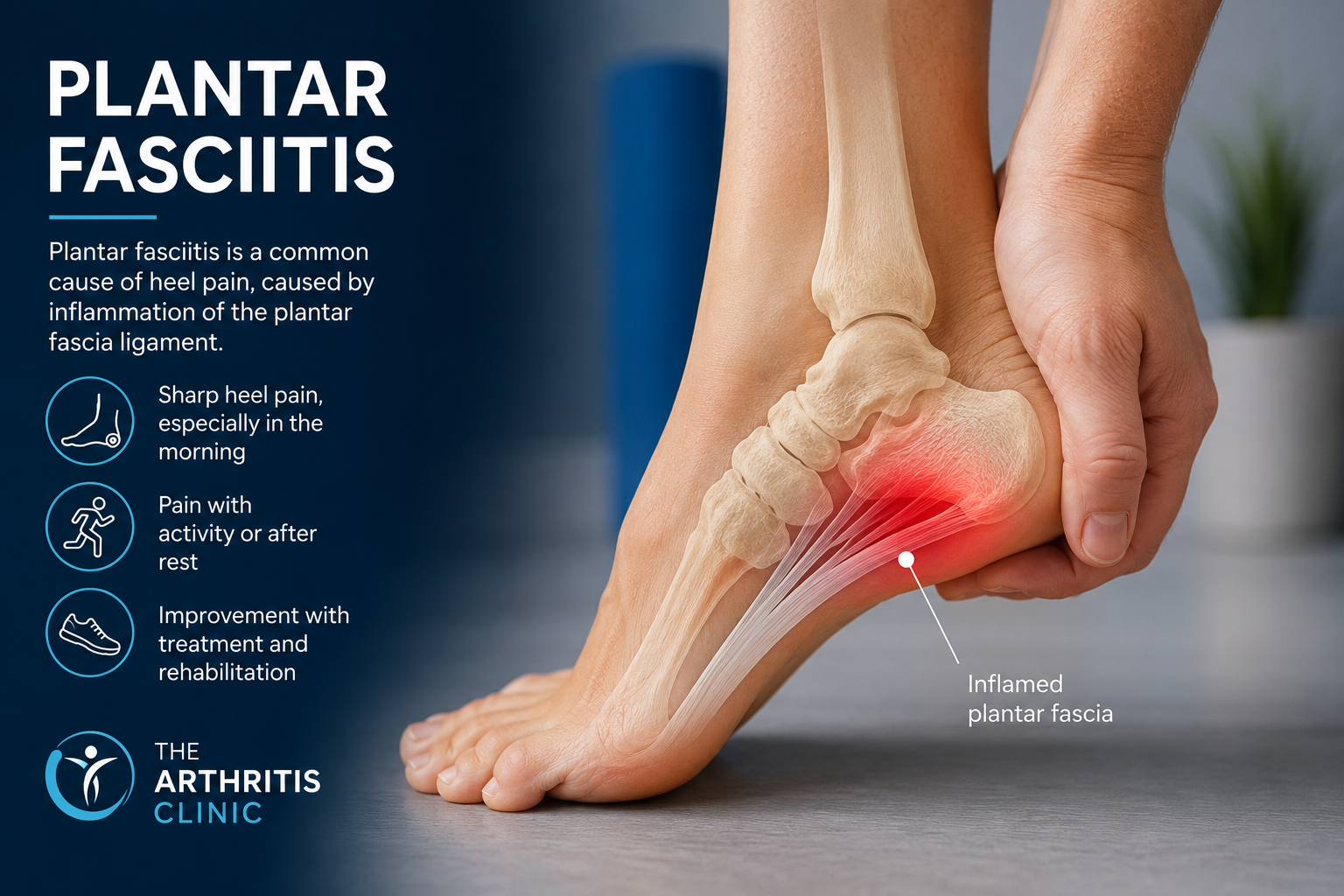
Plantar Fasciitis in Essex
Specialist Assessment and Treatment for Plantar Fasciitis in Billericay, Essex
Plantar fasciitis is a common cause of heel and foot pain. It typically causes pain underneath the heel or along the arch of the foot and can make walking, standing and exercise uncomfortable.
At The Arthritis Clinic in Billericay, Essex, we provide specialist assessment and treatment for plantar fasciitis and other causes of persistent heel pain. Our approach is focused on identifying the factors contributing to your symptoms and developing an appropriate treatment and rehabilitation plan.
What is plantar fasciitis?
The plantar fascia is a strong band of connective tissue that runs along the bottom of the foot, helping to support the arch and absorb load during walking and running.
Plantar fasciitis occurs when the plantar fascia becomes painful, usually around its attachment to the heel bone. Despite the name, plantar fasciitis is not always associated with significant inflammation. It is often considered a load-related condition involving changes within the plantar fascia and surrounding tissues.
Plantar fasciitis can affect people of all ages and activity levels.
What does plantar fasciitis feel like?
Typical symptoms include:
- Pain underneath the heel
- Pain around the inside of the heel
- Pain through the arch of the foot
- Pain that is particularly noticeable when taking your first steps after getting out of bed
- Pain after sitting or resting for a period of time
- Symptoms that worsen with prolonged standing or walking
- Discomfort during or after running and other impact activities
Some people experience relatively mild symptoms, while others can develop persistent pain that significantly affects their daily activities and exercise.
What causes plantar fasciitis?
There is rarely a single cause of plantar fasciitis. Symptoms can develop when the tissues of the foot are exposed to loads that they are not currently conditioned to tolerate.
Potential contributing factors include:
- A sudden increase in walking, running or sporting activity
- Changes in training volume or intensity
- Prolonged periods of standing
- Changes in footwear
- Reduced calf or ankle flexibility
- Reduced strength or conditioning of the foot and lower limb
- Changes in body weight
- Altered walking or running mechanics
- Previous foot or lower-limb problems
Importantly, having one of these factors does not necessarily mean that you will develop plantar fasciitis.
How is plantar fasciitis diagnosed?
Plantar fasciitis is usually diagnosed through a detailed clinical assessment.
Your assessment may include:
- A detailed history of your symptoms
- Examination of the foot and ankle
- Assessment of your walking pattern
- Assessment of ankle and calf movement
- Examination of foot and lower-limb strength
- Assessment of activity and training loads
- Consideration of footwear and occupational demands
Where clinically appropriate, musculoskeletal ultrasound may also be used to assess the plantar fascia and surrounding structures.
Ultrasound can help identify changes within the plantar fascia and can also help assess other potential causes of heel pain.
Other causes of heel pain
Not all heel pain is caused by plantar fasciitis.
Other possible causes include:
- Achilles tendinopathy
- Heel fat-pad problems
- Stress injury or fracture
- Nerve-related pain
- Other tendon disorders
- Inflammatory conditions
- Problems originating from the ankle or foot
A thorough assessment is therefore important, particularly when symptoms are unusual, severe or persistent.
Treatment for plantar fasciitis
Treatment depends on the severity and duration of your symptoms, your activity levels and the factors contributing to your condition.
Physiotherapy and rehabilitation
Exercise and rehabilitation are important components of managing plantar fasciitis.
Your programme may include exercises designed to improve:
- Calf strength
- Foot and ankle strength
- Plantar fascia capacity
- Lower-limb strength
- Balance and proprioception
- Tolerance to walking, running and other activities
The aim is not simply to reduce pain but to progressively improve the capacity of the foot and lower limb to tolerate everyday and sporting loads.
Activity modification
Complete rest is not always necessary.
Instead, we may recommend temporarily modifying activities that significantly aggravate your symptoms while maintaining appropriate levels of movement and exercise.
Your rehabilitation can then gradually progress as your symptoms and physical capacity improve.
Shockwave therapy
Shockwave therapy may be considered for some people with persistent plantar fasciitis, particularly when symptoms have not improved sufficiently with appropriate conservative management.
Extracorporeal shockwave therapy (ESWT) uses acoustic energy directed towards the affected area.
Evidence suggests that shockwave therapy can improve pain and function in some people with persistent plantar fasciitis, although responses vary between individuals.
At The Arthritis Clinic, we assess whether shockwave therapy is appropriate for you rather than automatically recommending it for every case.
Footwear and orthoses
Appropriate footwear can help some people manage symptoms.
Depending on your assessment, we may discuss footwear, activity modification or other strategies that may reduce excessive or irritating loads through the foot.
Orthoses may also be considered in selected patients, particularly where they form part of a wider rehabilitation programme.
Injection treatments
Injection treatment is not automatically required for plantar fasciitis.
If symptoms are persistent and other appropriate treatments have not provided sufficient improvement, injection options may sometimes be discussed following an individual assessment.
The potential benefits and risks of any injection treatment should be considered carefully before proceeding.
How long does plantar fasciitis take to improve?
Plantar fasciitis can be persistent, but many people improve with appropriate conservative management.
The recovery time varies considerably depending on factors such as:
- How long you have had symptoms
- Your activity levels
- The loads placed on the foot
- Your strength and conditioning
- Previous episodes of heel pain
- Other medical or musculoskeletal conditions
- How consistently rehabilitation can be undertaken
Rather than focusing solely on a specific recovery timeframe, treatment should be guided by your symptoms, function and ability to progressively tolerate load.
Can I continue exercising with plantar fasciitis?
In many cases, yes.
Stopping all activity is not necessarily required. However, you may need to temporarily modify activities that cause a significant increase in pain.
For runners and other active people, rehabilitation can focus on maintaining fitness while gradually rebuilding the foot’s tolerance to running and impact.
We can help you develop a structured return-to-activity programme based on your symptoms and goals.
When should I seek assessment?
Consider seeking professional assessment if:
- Your heel pain is persistent
- Symptoms are affecting your walking or work
- You are unable to exercise because of your pain
- Your symptoms are getting progressively worse
- You have tried self-management without sufficient improvement